Law of Sines

Law of Sines

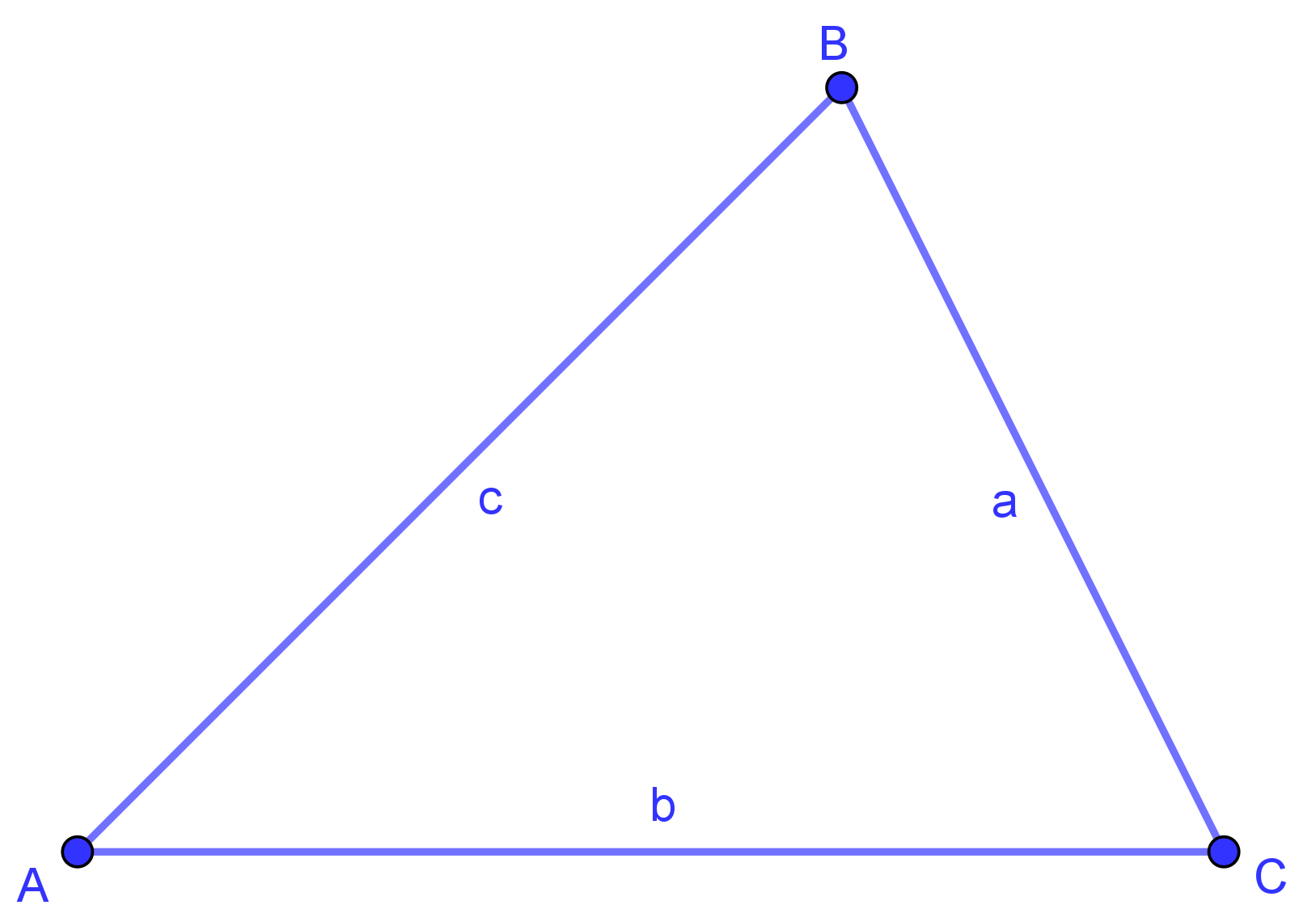
For a random ABC\triangle ABC, aa, bb, and cc are the length of the sides of the triangle, and seperately, A\angle A, B\angle B, and C\angle C are the opposite angles, then the Law of Sines points out:

asinA=bsinB=csinC=2R \frac{a}{\sin{\angle A}}=\frac{b}{\sin{\angle B}}=\frac{c}{\sin{\angle C}}= 2R

where RR is the length of the radius of the circumscribed circle of ABC\triangle ABC.


Derivation

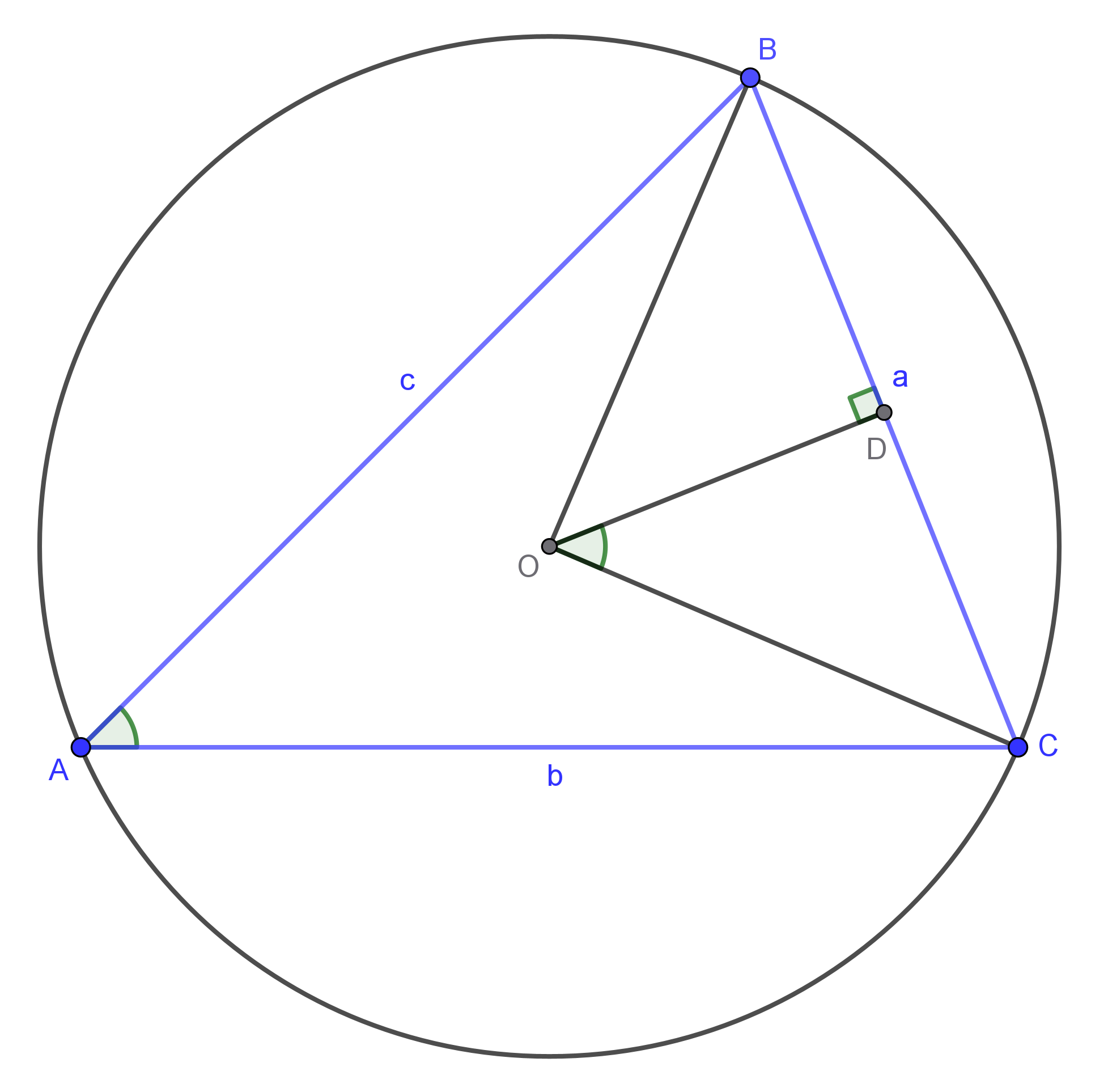
O\odot O is the circumscribed circle of ABC\triangle ABC; connect OBOB and OCOC; draw a prependicular line from OO to side BCBC and intersect with it at point DD.

Note that A\angle A is an inscribed angle, while BOC\angle BOC is the central angle subtending BC\overset{\frown}{BC}, which means:

A=12BOC\angle A=\frac{1}{2}\angle BOCOB=OC=R, ODBCBOD=COD=12BOC=AsinA=sinCOD=CDOC=12aR    asinA=2R \begin{align*} &\because OB=OC=R, \ OD\perp BC \\ &\therefore \angle BOD=\angle COD= \frac{1}{2}\angle BOC=\angle A\\ &\therefore \sin{\angle A}=\sin{\angle COD}=\frac{CD}{OC}=\frac{\frac{1}{2}a}{R}\\ &\implies \frac{a}{\sin {\angle A}}= 2R \end{align*}

Similarly, from other directions, we may also get:

bsinB=2R, csinC=2R\frac{b}{\sin {\angle B}}= 2R,\ \frac{c}{\sin {\angle C}}= 2R

Hence:

asinA=bsinB=csinC=2R \frac{a}{\sin{\angle A}}=\frac{b}{\sin{\angle B}}=\frac{c}{\sin{\angle C}}= 2R \tag*{$\blacksquare$}