Heron's Formula

Heron's Theorem

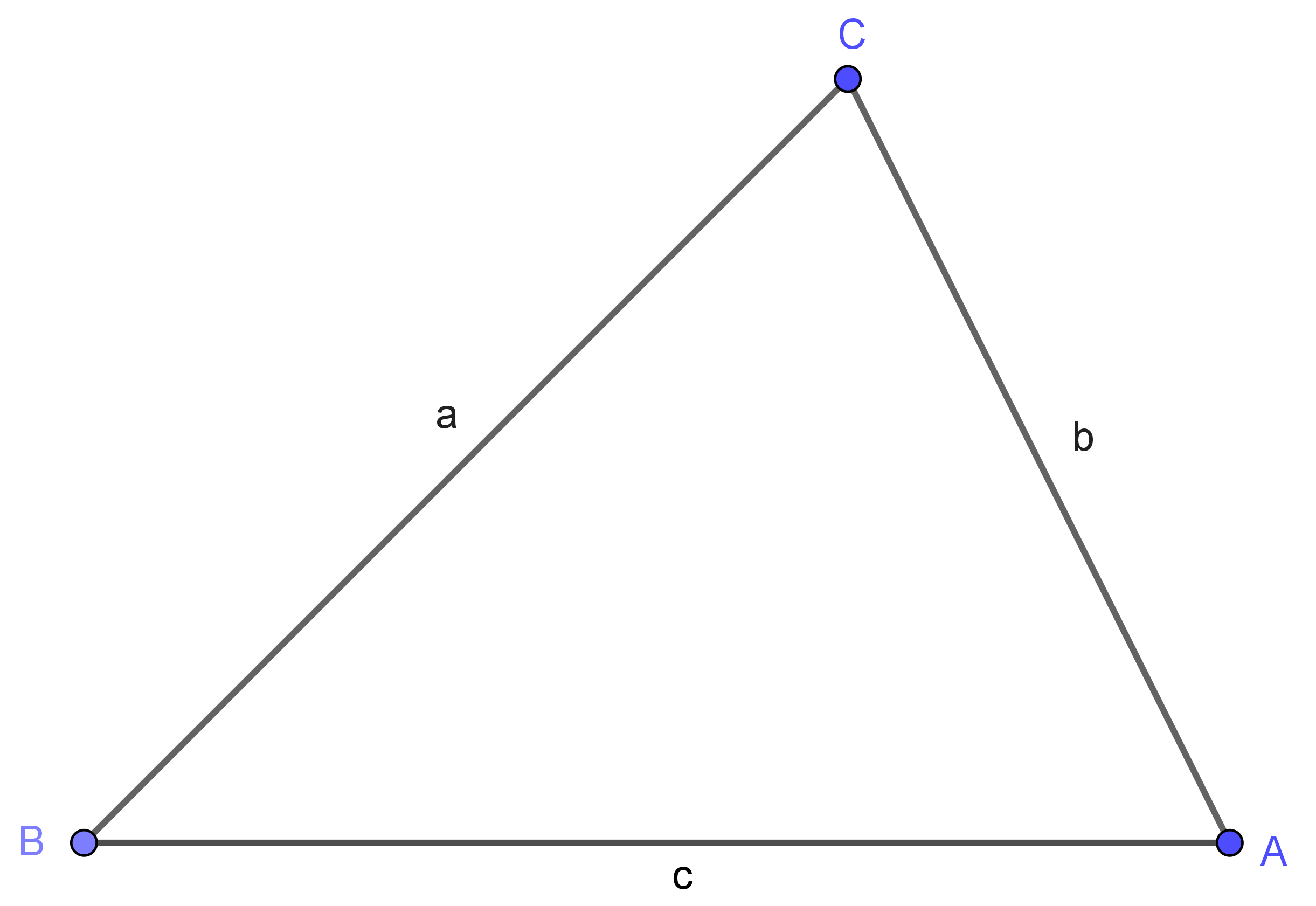
Given a ABC\triangle ABC with the side length aa, bb, and cc, then, the area is:

SABC=p(pa)(pb)(pc) S_{\triangle{ABC}}=\sqrt{p(p-a)(p-b)(p-c)}

where p=a+b+c2p=\frac{a+b+c}{2}, as half of the semiperimeter of ABC\triangle ABC

Qin Jiushao's formula

Alternatively, here is an equivalent form of Heron's formula

SABC=14[a2c2(a2b2+c22)2] S_{\triangle{ABC}}=\sqrt{\frac{1}{4}\left[a^2c^2-\left(\frac{a^2-b^2+c^2}{2}\right)^2 \right]}

Derivation

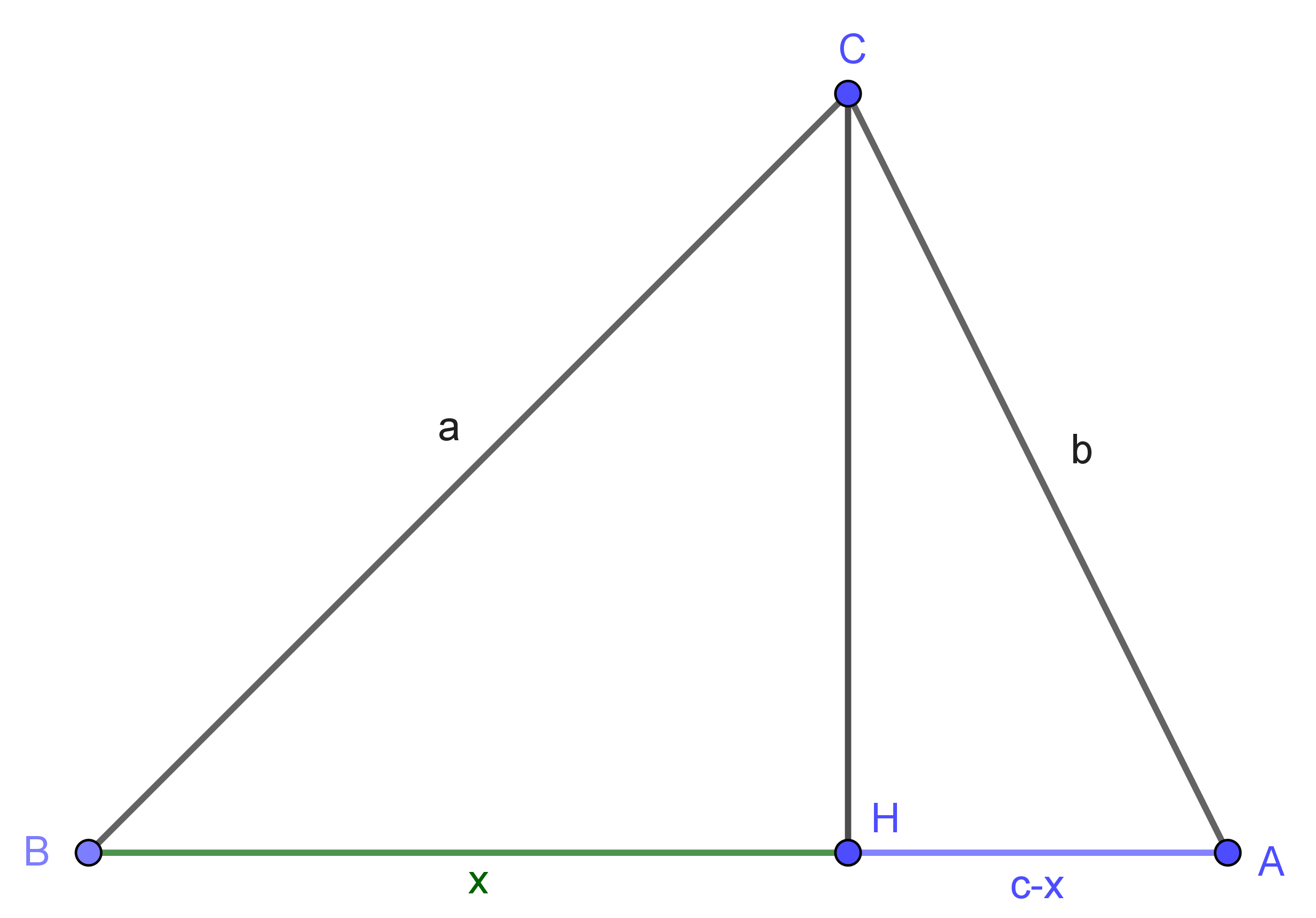
Let BHACBH \perp AC; HH is a point on ACAC.

From the Pythagorean Theorem, we get:

a2x2=b2(cx)2a2x2=b2c2+2cxx22cx=a2b2+c2x=a2b2+c22c\begin{align*} a^2-x^2&=b^2-(c-x)^2\\ a^2-x^2&=b^2-c^2+2cx-x^2\\ 2cx&=a^2-b^2+c^2\\ x&=\frac{a^2-b^2+c^2}{2c} \end{align*}
SABC=12ACBH=12ac2(a2b2+c22c)2=14[a2c2(a2b2+c22)2](Qin Jiushao’s formula)=116[4a2c2(a2b2+c2)2]=(2ac)2(a2b2+c2)216=(2ac+a2b2+c2)(2aca2+b2c2)16=[(a+c)2b2][b2(ac)2]16=(a+c+b)(a+cb)(b+ac)(ba+c)16=a+b+c2a+b+c2ab+c2a+bc2=a+b+c2(a+b+c2a)(a+b+c2b)(a+b+c2c) \begin{align*} S_{\triangle{ABC}}&=\frac{1}{2}AC\cdot BH \\ &=\frac{1}{2}a\cdot \sqrt{c^2-\left(\frac{a^2-b^2+c^2}{2c}\right)^2}\\ &=\sqrt{\frac{1}{4}\left[a^2c^2-\left(\frac{a^2-b^2+c^2}{2}\right)^2 \right]} &&\text{(Qin Jiushao's formula)}\\ &=\sqrt{\frac{1}{16}[4a^2c^2-(a^2-b^2+c^2)^2]}\\ &=\sqrt{\frac{(2ac)^2-(a^2-b^2+c^2)^2}{16}}\\ &=\sqrt{\frac{(2ac+a^2-b^2+c^2)(2ac-a^2+b^2-c^2)}{16}}\\ &=\sqrt{\frac{[(a+c)^2-b^2][b^2-(a-c)^2]}{16}}\\ &=\sqrt{\frac{(a+c+b)(a+c-b)(b+a-c)(b-a+c)}{16}}\\ &=\sqrt{\frac{a+b+c}{2}\frac{-a+b+c}{2}\frac{a-b+c}{2}\frac{a+b-c}{2}}\\ &=\sqrt{\frac{a+b+c}{2}\left(\frac{a+b+c}{2}-a\right)\left(\frac{a+b+c}{2}-b\right)\left(\frac{a+b+c}{2}-c\right)}\\ \end{align*}

Now, let p=a+b+c2p=\frac{a+b+c}{2}, then:

SABC=p(pa)(pb)(pc) S_{\triangle{ABC}}=\sqrt{p(p-a)(p-b)(p-c)} \tag*{$\blacksquare$}